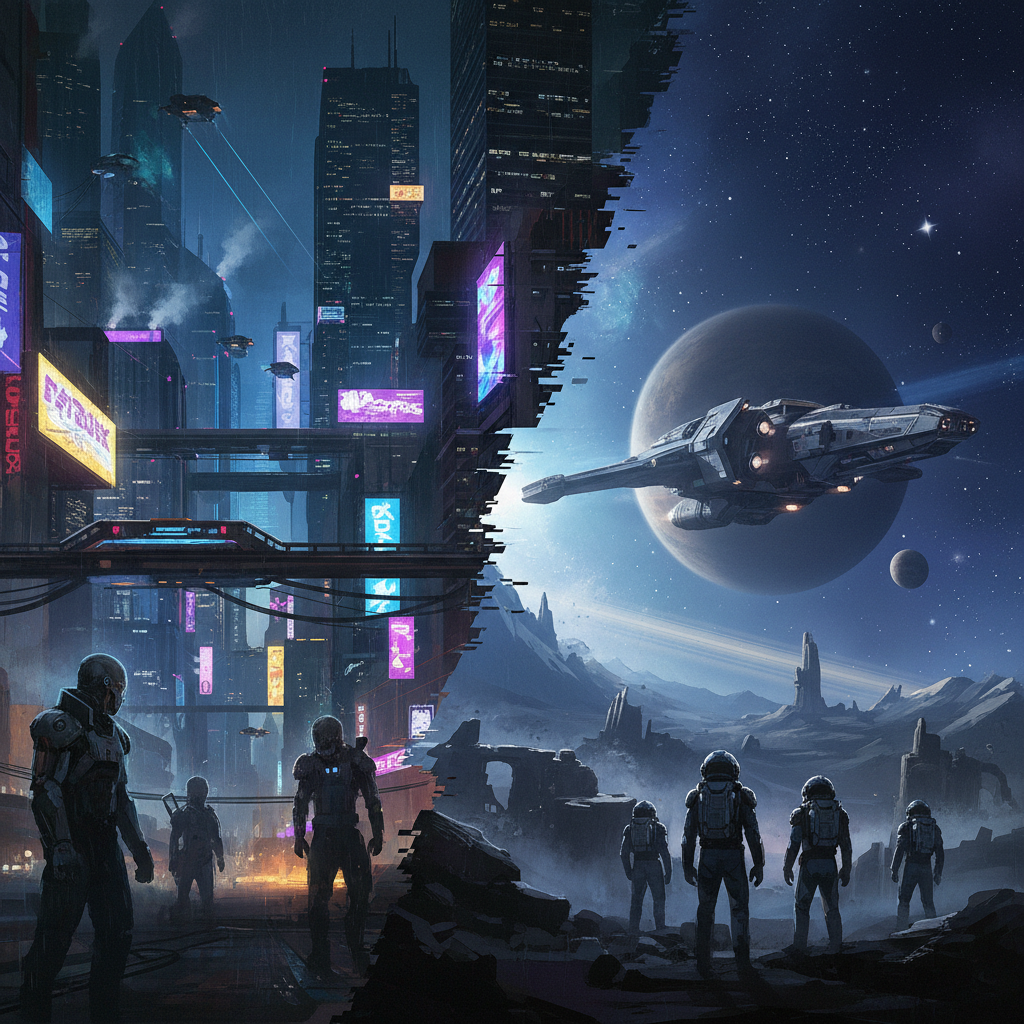
Open World Design
Cyberpunk 2077 and Starfield approach open-world design with distinct philosophies. Cyberpunk 2077 offers a single, continuous map, providing a seamless experience that prioritizes immersion within its narrative. The world of Night City, much like The Witcher 3’s open world, is crafted primarily to serve and enhance the game’s story and setting. While it contains numerous activities and areas to explore, its core function is to deepen the player’s engagement with the ongoing narrative.
In contrast, Starfield, typical of Bethesda Game Studios RPGs, presents its open world as a vast sandbox. This design emphasizes player freedom, allowing individuals to interact with its intricate systems and diverse content with considerable autonomy. The “Settled Systems” in Starfield boast extensive variety in activities and sights, and its systemic nature contributes to a more dynamic and reactive environment. However, this expansive world is segmented into many smaller areas connected by loading screens, differing from Cyberpunk 2077’s uninterrupted map. While Cyberpunk 2077 provides a unified, contiguous experience, Starfield’s brute force scale and systemic depth offer a different kind of open-world engagement.
Narrative and Storytelling
When it comes to narrative, Cyberpunk 2077 distinguishes itself significantly. Its focus on storytelling elevates it, especially following updates and the Phantom Liberty expansion. The writing, character development, and voice acting performances in Cyberpunk 2077 are highly regarded, creating a deeply engaging narrative experience.
Starfield’s main story is considered a solid experience and an improvement over past Bethesda RPGs in terms of storytelling. However, it does not reach the same level of narrative depth and impact as Cyberpunk 2077. While Starfield offers a strong foundation, Cyberpunk 2077’s dedicated narrative priorities give it a clear advantage in this category.
Combat Mechanics
Starfield’s combat system has received praise, exceeding expectations for a Bethesda title, particularly concerning its first-person shooter mechanics. The gunplay is described as enjoyable, and the inclusion of powers later in the game adds an interesting dimension. Space combat, while best in short bursts, contributes to the overall experience, as do elements like zero-gravity environments and unique extraterrestrial enemies.
Despite Starfield’s improvements, Cyberpunk 2077 generally takes the lead in combat, especially after its 2.0 Update. Before this update, issues with AI sometimes hindered the otherwise excellent weapon and combat mechanics. However, in its current state, Cyberpunk 2077 consistently delivers thrilling, high-energy shootouts that are often more kinetic and explosive than those found in Starfield.
RPG Systems and Player Choice
Both Cyberpunk 2077 and Starfield offer robust RPG systems, particularly after Cyberpunk 2077’s 2.0 Update overhaul. Both titles feature impressive build variety and skill trees filled with rewarding unlocks that significantly influence gameplay. Bethesda Game Studios has a long history of excelling in this area, so Starfield’s strong performance here is expected. Cyberpunk 2077, through its radical overhauls to progression and customization, has significantly closed the gap, standing on relatively equal footing with Starfield in this department.
Regarding choice and consequence, the games again cater to different preferences. Starfield excels in offering absolute freedom and extreme player agency. The entire galaxy is largely accessible from the outset, with minimal restrictions on exploration and actions. This aligns with the traditional Bethesda approach, where player freedom is paramount. However, this often means that Starfield, like other BGS RPGs, does not typically lock players out of significant content based on past decisions.
Cyberpunk 2077, being more tied to its narrative vision, cannot replicate this level of absolute freedom. However, if a player seeks a game where choices carry significant weight and have noticeable consequences, Cyberpunk 2077 is considered to offer a deeper experience. Player decisions in Cyberpunk 2077 can have more profound and lasting impacts on the story and available content.
FAQ
Which game offers better value right now? Based on recent metrics, Cyberpunk 2077 currently offers better value, often available at a significantly lower price with strong reviews and an active player base. It has seen a 70% discount compared to Starfield’s 22% discount.
Which game is more popular? Cyberpunk 2077 shows higher popularity metrics, including an average of 51.7K concurrent players over 14 days compared to Starfield’s 4.3K. It also has a much larger total number of Steam reviews and recommendations.
Which game has better critical and user reception? Cyberpunk 2077 has an 86/100 Metacritic score and 87.1% positive Steam reviews. Starfield has 58.8% positive Steam reviews, indicating more mixed opinions.
Which game was released first? Cyberpunk 2077 was released on December 9, 2020, while Starfield was released on September 5, 2023.
Do both games have great soundtracks? Yes, both Cyberpunk 2077 and Starfield are noted for having great soundtracks.
Are both games single-player RPGs? Yes, both Cyberpunk 2077 and Starfield are described as single-player RPGs with action elements.
Which game has more supported languages? Cyberpunk 2077 supports 19 languages, whereas Starfield supports 9 languages.
Which game has more achievements? Starfield has 82 achievements, while Cyberpunk 2077 has 57.